Kafkaesque Market

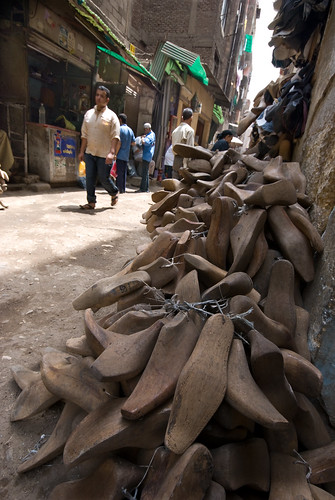 [Khan El-Khalili, Cairo, May 2008.]
Khan El-Khalili is the major market area in Cairo. This is a pile of shoe moulds in one of its alleys.
I wrote this in my diary while in Cairo:
"I sat in the market at 9am this morning and watched a Kafkaesque scene when the stalls opened. Each owner swept their store-front of dirt and rubbish and put it in front of the neighbouring stall, so the rubbish wasn't reduced, just moved around."
I continue in the same entry:
"It feels like I haven't worked for months [actually two weeks]. And yet in many ways I am still working. Work is [or, has become] taking a plane, getting through immigration, getting to my hotel, then seeing all the required sights while taking photos. Work is what I feel I have to do. I feel I have to see the pyramids or go to the Egyptian Museum. Each sight is demanding my attention. It is on a list of things I should do. Not that I won't enjoy them when I am doing them, but I must prioritise these options above others that more suit my character. My character? It is lazy, reluctant to be compelled to do something. So when I do a necessary thing I become stressed -- I lose my character, or, rather, I lose my ability to find my character."
In his beautiful history of the city Cairo: The City Victorious Max Rodenbeck writes: "There remains a sensible antiquity to the rhythm of the Old City, to the worn texture of every surface and the intimate scale of public space. The narrow lanes away from the main streets may no longer be overhung by the traditional tiered upper floors that closed out the sky and brought welcome shade in the summer, but they are still no wider than the medievally prescribed breadth of two laden camels, and still they are largely pedestrian."
Max Rodenbeck writes: "There remains a sensible antiquity to the rhythm of the Old City, to the worn texture of every surface and the intimate scale of public space. The narrow lanes away from the main streets may no longer be overhung by the traditional tiered upper floors that closed out the sky and brought welcome shade in the summer, but they are still no wider than the medievally prescribed breadth of two laden camels, and still they are largely pedestrian."Gustave Flaubert wrote of the old alleys in his notebook for 9th January 1850:
wrote of the old alleys in his notebook for 9th January 1850:"I keep losing my way in the maze of alleys and running into dead-ends. From time to time I come on an open space with the debris of ruined houses, or rather no houses; hens pecking, cats on walls. Quiet way of life here -- intimate, secluded. Dazzling sun effects when one suddenly emerges from these alleys, so narrow that the roofs of the moucharbiehs [shuttered bay windows] on each side touch each other."
Much more recently, the cantankerous V. S. Naipaul describes a Cairo market:
describes a Cairo market:"Cairo revealed the meaning of the bazaar: narrow streets encrusted with filth, stinking even on this winter's day; tiny shops full of shoddy goods; crowds; the din, already barely supportable, made worse by the steady blaring of motorcar horns; medieval buildings partly collapsed, others rising on old rubble, with here and there sections of tiles, turquoise and royal blue, hinting at a past of order and beauty, crystal fountains and amorous adventures, as perhaps in the no less disordered past they always had done."


 Posts
Posts

