Showing posts with label 2008. Show all posts

Tuesday, 20 January 2009

The Narrative: Part 1


[Grand Central Station, New York City, May 2008.]


It is a truism that a destination is never exactly as you expect it to be. Multiple factors undermine the purity of desires. The weather determines your impressions more than the architecture; authenticity is diluted by coca colonisation; ease is impeded by language barriers; insouciance is defeated by tiredness; freedom is curtailed by financial limits; and so on. All these factors are present in my everyday at home, but somehow I imagine them vanishing in a distant land of travel utopia. And luckily I persist with these delusions, no matter how statistically improbable their success becomes after the failures mount up, for I would embark on fewer quests without them. But the delusions have now become ironic. It is only natural to desire the perfect encounter with a destination, but thankfully reality steps in.
The travel utopia doesn't exist outside my mind because it has no narrative. Before seeing the museum's masterworks I must wait in line for two hours; before waiting in line I must eat breakfast at an over-priced cafe. Utopias don't have narratives, but narratives are the things that make a trip a trip. I need obstacles to trip myself up, to make me see the everyday as a local would see it, not as a tourist.


Tuesday, 13 January 2009

New York Public Library


[New York Public Library, May 2008.]


I'm a librarian (albeit a corporate librarian), but I don't read in libraries like this woman. It has to do with my bowels.

I exaggerate. But there is something about bookshops and libraries that induces bowel movement in a lot of people. The common "something" shared by these two most venerable establishments is, of course, books. Books are laxatives. Masses of unread books produce anxiety. It is like public speaking. You stand before aisles of unread books and it is the same as standing before the law. They judge your ignorance.

Before the Law is, of course, is the title of the most famous parable by Franz Kafka, which can be found in his Complete Stories. "Before the law", it begins, "stands a doorkeeper. To this doorkeeper there comes a man from the country and prays for admittance to the Law. But the doorkeeper says that he cannot grant admittance at the moment." The man waits his whole life, dying on the doorstep. Just before his last breath he asks the doorkeeper one last question: "'Everyone strives to reach the Law,' says the man, 'so how does it happen that for all these years no one but myself has ever begged for admittance?' The doorkeeper recognises that the man has reached his end, and, to let his failing senses catch his words, roars in his ear: 'No one else could ever be admitted here, since this gate was made just for you. I am now going to shut it.'"

This short story was published in Kafka's lifetime, but it is also part of his posthumously published novel, The Trial. The multiple meanings of the parable are discussed at length by the teller of the tale, a priest, and the novel's main protagonist, Joseph K. However, they do not discuss the ignorance of the man for failing to notice that no one else enters his door. 

Each book in a library is for you. You are ignorant before it. And you may be ignorant after it too, depending on how good it is. But you can't judge it till you open it. You can't judge a book by its cover. But it judges you if you don't enter into its world.


Sunday, 11 January 2009

Do Not Go Gentle


[Stardust, Italy, Rome, May 2008.]


My last night in Rome I finally found a bar that suited my taste. I had struggled all week to see some jazz. Each time I went to a place it was either closed or much further away than I had expected, so I went home. Stardust was also mentioned in the Lonely Planet guide as playing some jazz now and again, so I went forth. It also says that the crowd is Boho (Bohemian) and that I can vouch for. Most remarkably for me, it had women who had great spirit. I talked to several patrons. One in particular could speak good English as he had lived in England for a few years. His name was Derek. I said, "There isn't even a K in the Italian alphabet." He laughed, but I never discovered the reason for the spelling.

[Jack Russell playing with a drunk and a plastic bottle.]

Running around the bar was a Jack Russell, so I spent a while playing with him, as did a good proportion of the other drunks. I mentioned to Derek how silly it was that Italian lighters had a cartoon stuck to them explaining how to use the child-proof action. He admitted their stupidity and said that children collected the stickers (I hoped he was being ironic). Towards the end of the night, a diminutive guy with large hair stood on the bar, quietened everyone, then performed Dylan Thomas' poem "Do not go gentle into that good night" in Italian. I could hear the familiar cadences even if in a sense I couldn't understand the Italian words:


Do not go gentle into that good night,
Old age should burn and rave at close of day;
Rage, rage against the dying of the light.
Though wise men at their end know dark is right,
Because their words had forked no lightning they
Do not go gentle into that good night.
Good men, the last wave by, crying how bright
Their frail deeds might have danced in a green bay,
Rage, rage against the dying of the light.
Wild men who caught and sang the sun in flight,
And learn, too late, they grieved it on its way,
Do not go gentle into that good night.
Grave men, near death, who see with blinding sight
Blind eyes could blaze like meteors and be gay,
Rage, rage against the dying of the light.
And you, my father, there on the sad height,
Curse, bless me now with your fierce tears, I pray.
Do not go gentle into that good night.
Rage, rage against the dying of the light.

[A recitation of Dylan Thomas in Italian. When I become leader of the free world I would institute the law that all pubs engage a patron to recite this poem at closing time.]


Saturday, 10 January 2009

Crawford Market


[Crawford Market, Mumbai, May 2008.]


Markets are one of my favourite things to visit while travelling or at home. You can tell how much soul a city has by the character of its markets. 
I visited Crawford Market twice. The first time I was told that I had to have an official guide because I was a foreigner. Several small men pointed to the sign in English to confirm this. I walked out in frustration that day, but came back later in the week and to be honest my guide was excellent. He spoke very little English, but he made up for it with pointing calmly at details I wouldn't have noticed.


It was late afternoon when I arrived. I'd already walked aimlessly for at least three hours, and played a game of cricket on the pavement with some boys. They watched me roll a cigarette then came up to me with the entreaty "Match?" As it was nearly 40c, it wasn't long before my shirt was completely wet with sweat. In short, I was tired by the time I reached the market. 

[The main entrance. After Indian independence the market was renamed the Mahatma Jyotirao Phule Market, which can made out on the arch in this photo.]


[The basket man (left) was reflected in the friezes on the archway. These were designed by Lockwood Kipling, Rudyard Kipling's father.]


[Mangoes were in season. 90% of the fruit stalls were selling them, and only them. The boy (left) is "sweeping" the straw with his feet.] 


[The poultry section of the market (left). As you can see, it was long closed for the day when I went through. A cat and a couple of crows (the latter can be seen in the photo) were the only customers.]                       


Thursday, 8 January 2009

Intolerable Presence


[Another view from the hotel balcony in Cairo, May 2008.]


I am going to Vietnam in a month. Yesterday I began reading Norman Lewis' travelogue through South-East Asia in 1950, A Dragon Apparent: Travels in Cambodia, Laos, and Vietnam and found this quote:
"It was all very entertaining to a stranger completely fresh from the West, but from the experiences of these few hours I had learned one disturbing thing. This was that as a European I had been invisible. My eyes never met those of a Vietnamese. There was no curious staring, no gesture or half-smile of recognition. I was ignored even by the children. The Vietnamese people, described by early travellers as gay, sociable and showing a lively curiosity where strangers were concerned, have now withdrawn into themselves. [...] It is as if a general agreement has been reached among them that this is the best way of dealing with an intolerable presence."

Although the situation in occupied Indochina during the fifties is a completely different kettle of fish, this discription captures for me the same sense I sometimes get walking in a foreign city. I felt it occasionally while walking around Cairo as a "Westerner". To describe it as hostility is too strong a word. And indifference is too weak a word. It is better described as feeling unwelcome. It has more to do with my own unease in being a "Westerner" than any actual unwelcomeness on the Cairenes' part. 

Other related blogs:
Cairo


Wednesday, 7 January 2009

Taxi Drivers, Immigration Officers, and Jetlag


As we were leaving the airport, the taxi driver asked me if I liked India. I said I've only been here ten minutes. That was a lie. Firstly because I'd waited half an hour for another taxi driver to find him. He was in a restaurant or something. I'd paid in advance in the terminal so I couldn't jump in another taxi. Then, secondly, earlier I'd had an immigration officer who only reluctantly took my passport. She even went to pick up her newspaper again before resigning to the fact of my existence (and her job). When she did look at my passport she said "Broadhead" then laughed, and the smile didn't leave her face for the full two minutes I was in front of her. I made her day complete when she repeated the refrain "Broadhead [laughter]" as she stamped my entry date. I wanted to ask her what her surname was, but I didn't want to get back on the next plane to Cairo.


A week earlier the immigration officer at Cairo airport (actually both of them -- inbound and outbound) thought it amusing to question my intelligence. I bought a Egyptian tourist visa for 80 pounds at a strategically placed stall in the terminal. When I handed it to the immigration officer with my passport, he said "Why didn't you stick it in your passport?" As if I knew I was supposed to do so because I come here every day. He continued by demonstrating how to do it by peeling off its waxed back ... "Look, magic". 

[The photo is of a Mumbai taxi or two, taken from a Mumbai taxi (though not on the day of my arrival). Taken with my Nikon D80 and fitted with a Sigma 10-20mm. May 2008.]


Tuesday, 6 January 2009

Along Nanjing to the Bund


[Nanjing Rd, Shanghai, May 2008]


On the 21st May 2008 I wrote in my diary: 
"I am in a restaurant in the French Concession called Sasha's. Bit up-market for me. I am surrounded by rich Shanghai women eating lunch. I have a pint of beer. Last night I walked along Nanjing Rd, being hounded by two touts, one spruiking women ("massage"), the other fake goods (I apparently need a new watch).I endured their questions because I needed a light (airports steal my lighters). Then I found a convenience store and I couldn't get rid of them (they followed me in and, much to my consternation, wanted to help me choose a drink and get a lighter). The watch-tout gave up on me shortly after the convenience store. I endured the massage-tout for another 400m till we reached the Bund. My head was buzzing with the adrenalin of getting off an international flight at night. It is more sensible to arrive anywhere in the morning, because you can find your bearings easier, get around easier, etc., but it is ten times more fun to arrive at night. And the Bund added to this enjoyment."


[The group on the left are looking at jewellery on a small stall. The guys squatting on the right are selling a rotating "laser" toy. The buildings in the background are selling capitalism. Shanghai, May 2008.]

The Bund is like a pier. People wander along it, take in the views, buy some food or cheap trinkets, watch passers-by, practice dancing on its smooth pavement, etc. Like a pier you go nowhere. You walk up and down. It is an end in itself.

Saturday, 3 January 2009

Kafkaesque Market


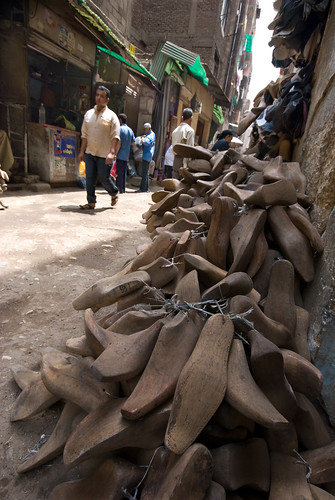
[Khan El-Khalili, Cairo, May 2008.]


Khan El-Khalili is the major market area in Cairo. This is a pile of shoe moulds in one of its alleys. 

I wrote this in my diary while in Cairo:
"I sat in the market at 9am this morning and watched a Kafkaesque scene when the stalls opened. Each owner swept their store-front of dirt and rubbish and put it in front of the neighbouring stall, so the rubbish wasn't reduced, just moved around."

I continue in the same entry:
"It feels like I haven't worked for months [actually two weeks]. And yet in many ways I am still working. Work is [or, has become] taking a plane, getting through immigration, getting to my hotel, then seeing all the required sights while taking photos. Work is what I feel I have to do. I feel I have to see the pyramids or go to the Egyptian Museum. Each sight is demanding my attention. It is on a list of things I should do. Not that I won't enjoy them when I am doing them, but I must prioritise these options above others that more suit my character. My character? It is lazy, reluctant to be compelled to do something. So when I do a necessary thing I become stressed -- I lose my character, or, rather, I lose my ability to find my character."

In his beautiful history of the city Cairo: The City VictoriousMax Rodenbeck writes: "There remains a sensible antiquity to the rhythm of the Old City, to the worn texture of every surface and the intimate scale of public space. The narrow lanes away from the main streets may no longer be overhung by the traditional tiered upper floors that closed out the sky and brought welcome shade in the summer, but they are still no wider than the medievally prescribed breadth of two laden camels, and still they are largely pedestrian."

Gustave Flaubertwrote of the old alleys in his notebook for 9th January 1850:
"I keep losing my way in the maze of alleys and running into dead-ends. From time to time I come on an open space with the debris of ruined houses, or rather no houses; hens pecking, cats on walls. Quiet way of life here -- intimate, secluded. Dazzling sun effects when one suddenly emerges from these alleys, so narrow that the roofs of the moucharbiehs [shuttered bay windows] on each side touch each other."

Much more recently, the cantankerous V. S. Naipauldescribes a Cairo market:
"Cairo revealed the meaning of the bazaar: narrow streets encrusted with filth, stinking even on this winter's day; tiny shops full of shoddy goods; crowds; the din, already barely supportable, made worse by the steady blaring of motorcar horns; medieval buildings partly collapsed, others rising on old rubble, with here and there sections of tiles, turquoise and royal blue, hinting at a past of order and beauty, crystal fountains and amorous adventures, as perhaps in the no less disordered past they always had done."


Friday, 2 January 2009

That Awful Mess

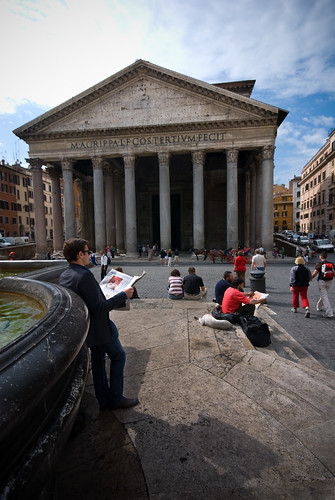
[The Pantheon, Rome, May 2008.]

I spent a week (or thereabouts) in Rome. On this particular day I managed to buy and lose a copy of That Awful Mess on the Via Merulana by Carlo Gadda. 

I had traipsed across the Tiber to a little English language bookshop called the Almost Corner Bookshop. As is usual for me when travelling, I had trouble finding it, even though it was exactly where the map said it would be. 
Expectations seem to blind me to reality. I expect a bookshop to look like such and such, and instead it looks more like what I'd expect a haberdashery to look like from the outside.

In any case, that evening I returned to my hostel after reading only a few dozen pages, and left it by mistake in the hostel's bar. Ten minutes later I went back to retrieve it. But one of the drunken Australians or British backpackers had pocketed it. I scrutinised each one of them for the rest of the week, and I couldn't imagine any of them enjoying a modernist novel about a murder in 1930s Rome.


Thursday, 1 January 2009

Banker


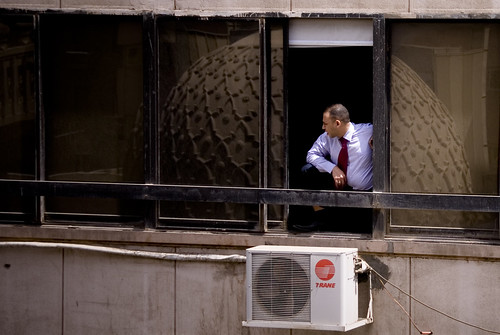
[Cairo, May 2008.]


This is an Egyptian leaning out of Banque Misr. I took this from the balcony of the hotel I was staying in across the road on the fifth floor. 

A few doors down from the hotel was a mosque and a Coptic church. You can see the mosque reflected in the bank's windows. 

This combination of a bank and a mosque reminds me that Islamic law (Shariah) forbids usury. The Qur'an: "Those who charge riba [usury] are in the same position as those controlled by the devil's influence." Furthermore, Muslim banks must not lend money to individuals or organisations that are contrary to the laws of Islam. 

Instead of charging interest, Muslim banks work with other systems, like profit sharing. The Wikipedia page on Islamic banking lists the methods they use.

Two hundred metres down the street (in the same direction the banker is looking) is the intersection named after the founder of Banque Misr, Mohamed Talaat Pasha Harb. In the middle of Medan Talaat Harb is a statue of the man himself.


[Medan Talaat Harb, Cairo, May 2008.]
Click on this photo to see a cat sitting under the statue. Even from the pavement I could hear it meowing. Occasionally it would try to get across the road, then sit back down in the shade. I presume it had slept there the night before and woke up when the traffic was too busy to escape. I thought about rescuing it, but the stray cats in Cairo were very shy of humans.


Just below my hotel was a take-away kebab shop. The lamb is cooked outside and several stray cats hang around waiting for scraps. One night I came back drunk and asked the man in charge of the rotisserie to sell me some meat for the cats. He took a few pounds from me and went inside for a receipt for the purchase. As I was feeding the cats a guy passed saying, "You are very kind," in broken English.


The Egyptians are very kind to cats. I wondered whether this was part of their ancient history. However, I discovered that it probably has more to do with more recent world history. In the Qur'an it tells of how a cat fell asleep on the Prophet Mohammed's cloak. Instead of waking it up when it was time to move, the Prophet cut a circle in his cloak around the cat.